Reusable research for coding tools
RLM Agent
Keep research findings and their sources available for your next coding session.
Public source codeLocal setup required
RLM Agent case study
The problem Findings from one research session can be hard to reuse when notes and sources are kept separately.
How it works
From a research question to reusable findings
Illustrative local research flow · model providers depend on configuration
Start with a research question and how much detail the answer needs.
A clear question and scope.
Look for relevant papers and other references through the configured source tools.
References available for review.
Review the retrieved material for findings relevant to the research question.
Findings with source references.
Combine the useful findings while retaining their sources and any reported gaps.
A research response to inspect.
Store findings locally so later coding sessions can look up previous work.
Research that can be revisited.
If a source cannot be reached, report it and continue with the references that are available.
Available references and a note about what is missing.
- Who it helps
- Developers and researchers who want to build on earlier findings without repeating the same searches.
- The experience
- Research findings and their sources remain available to the next coding session.
The design decision
Carry the sources forward with the findings.
Save the research and the references behind it together, so later coding sessions can revisit the reasoning and build on earlier work.
Availability
What you can explore today
Review the public source code and setup instructions. The tool runs locally and connects to compatible coding tools through MCP, a protocol for connecting tools and data. Model-provider access depends on your configuration; this is not a hosted app.
How this workflow may relate to you
Keeping findings and sources together could help teams build on earlier research instead of starting again.
Technology comparisons
When a tool choice needs several rounds of research, collect documentation and tradeoffs against shared criteria. Keep the references available as requirements change.
Project handoffs
When someone joins work already in progress, organize the research, sources, and unresolved questions into a reusable starting point for the next person.
Recurring research briefs
When a topic needs regular review, build on earlier findings, add newly checked sources, and flag conclusions that need another look before the brief is shared.
These are possible adaptations, not current product features. Each would be scoped around your information, access permissions, and review needs.
Explore document search and assistantsExample output
See a sample result.
A local test run using prepared sample data and source references. It shows the response format, not a live research benchmark.
View the sample research run ↗View the sample result

Explore the architecture and implementation record
Behind the experience
Architecture and implementation records from July 2026. These describe the documented build, not a current performance guarantee.
Open the architecture graphic ↗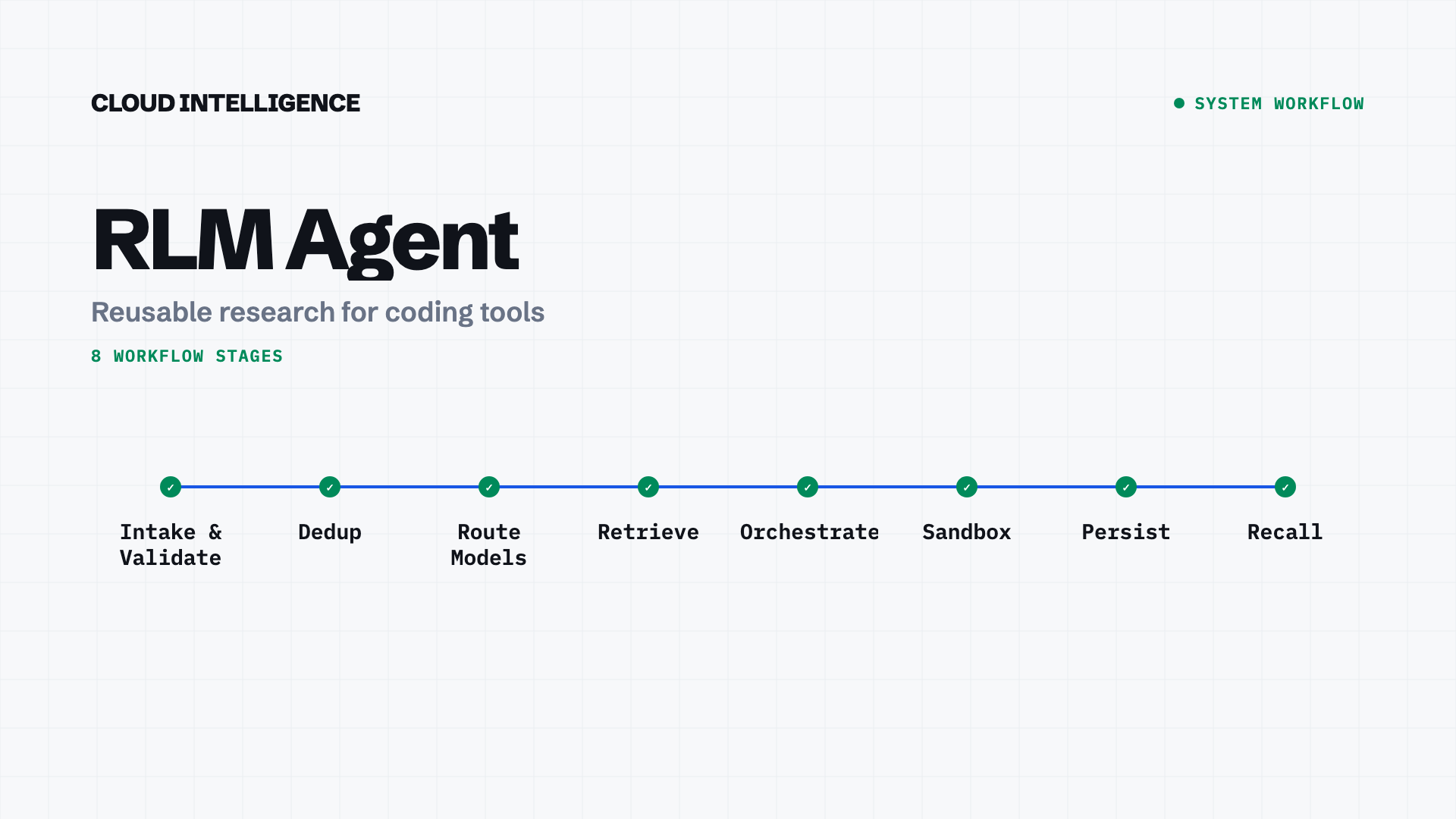
Have a workflow like this?
Start with what people need to do. Mention RLM Agent and we can explore which ideas fit your problem.